Interview with Friends House Resident, Elaine Yamada
Five years ago, right after Elaine Yamada had moved into her ground-floor apartment in the brand-new Lodge 1, a deer and a fawn “welcomed” her by showing up right outside her window. These days, she often catches glimpses of deer, foxes, woodpeckers, owls, and red-shouldered hawks in the woods beyond her back patio.
She confesses, “As a burgeoning naturalist, it is a joy to be so surrounded by nature.”
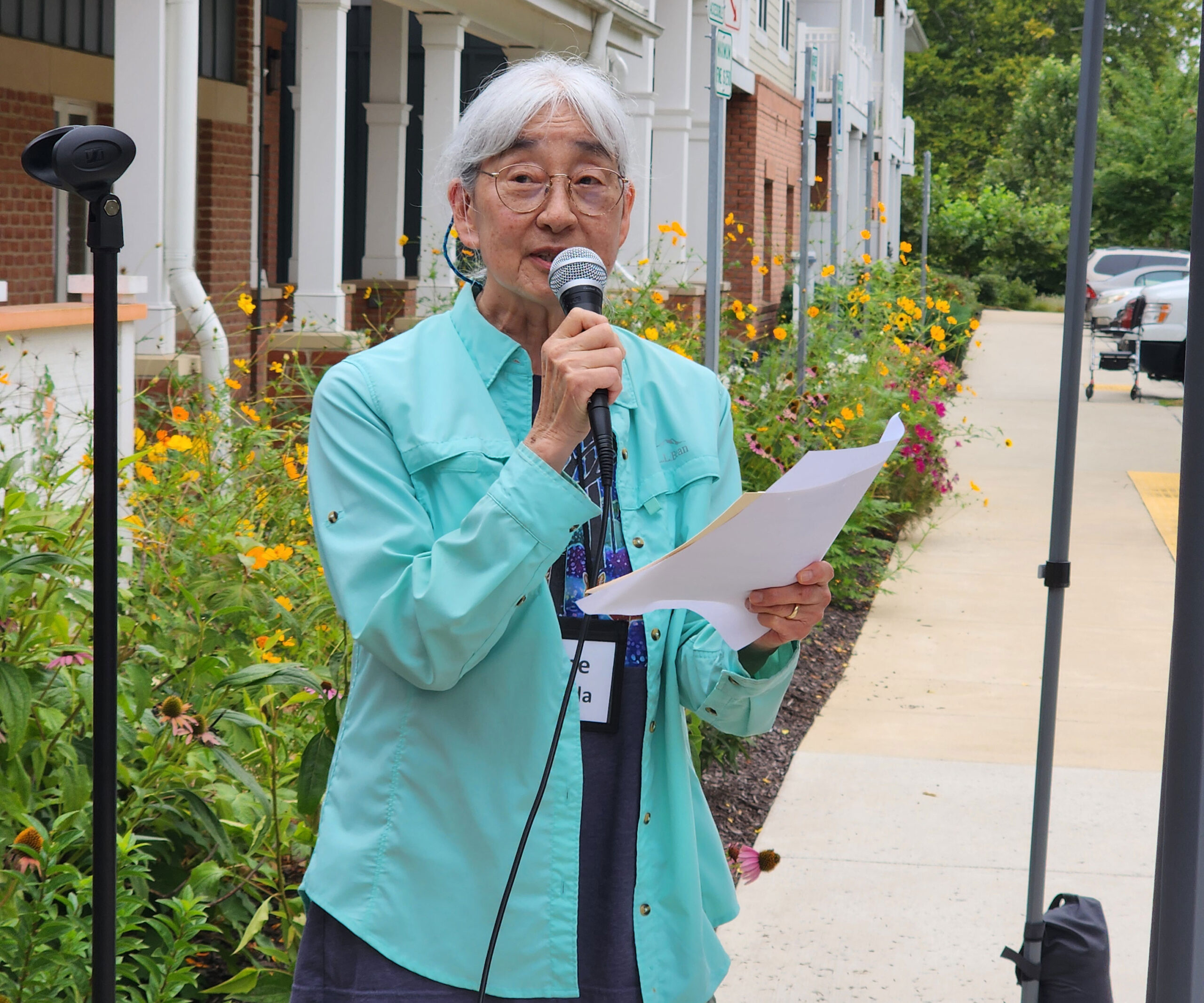
However, soon after Elaine and her Lodge 1 neighbors arrived at Friends House, they became concerned about the hillside erosion in their backyard caused by the runoff from heavy rains. Elaine and her neighbors joined together to research possible solutions to the problem, finally settling on a native-plant meadow as the best deterrent to the problem. The Administration fully supported this idea. Recently, the group’s efforts were rewarded when Friends House received funding for their meadow from a grant given to the Anacostia Riverkeepers. (The grant application reflected Riverkeeper’s technical expertise along with Friends House Quaker values, a winning combination.)
The meadow process confirmed for Elaine that she had made the right choice in moving to Friends House. “As an introvert, I found working with others on this meaningful project a rewarding way to enter this new community.”
Elaine’s involvement in this initial endeavor led to her joining the Environment Committee. These days the committee’s focus has been on replacing many invasive plants across the campus with native ones.
Why is this important?
Elaine explains, “We all knew that the world was losing species by the handfuls, due to the loss of habitat and widespread pesticide use, as well as the displacement of native plants by invasive species.”
Native plants provide nectar and pollen and serve as host plants for beneficial native insects and larvae, especially caterpillars. These tiny creatures form the bottom of the food chain, sustaining other animals and contributing to a balanced ecosystem.
The Environment Committee’s efforts encouraging native plantings were rewarded when Friends House was recently designated a Certified Wildlife Habitat by the National Wildlife Federation, replete with a metal sign by the Administration Building’s entrance. Both this sign and a new plaque next to it from the Home-grown National Park organization were proudly unveiled at an August ceremony, attended by many residents who applauded this proof of Friends House commitment to biodiversity across the campus.
Friends House CEO Philip Burkholder cited how these honors “reflect nearly six decades of environmentally sustainable practices at Friends House.”
Or as Elaine put it, “They are two major feathers in our cap—and another boon to the environmental credentials of our campus!”